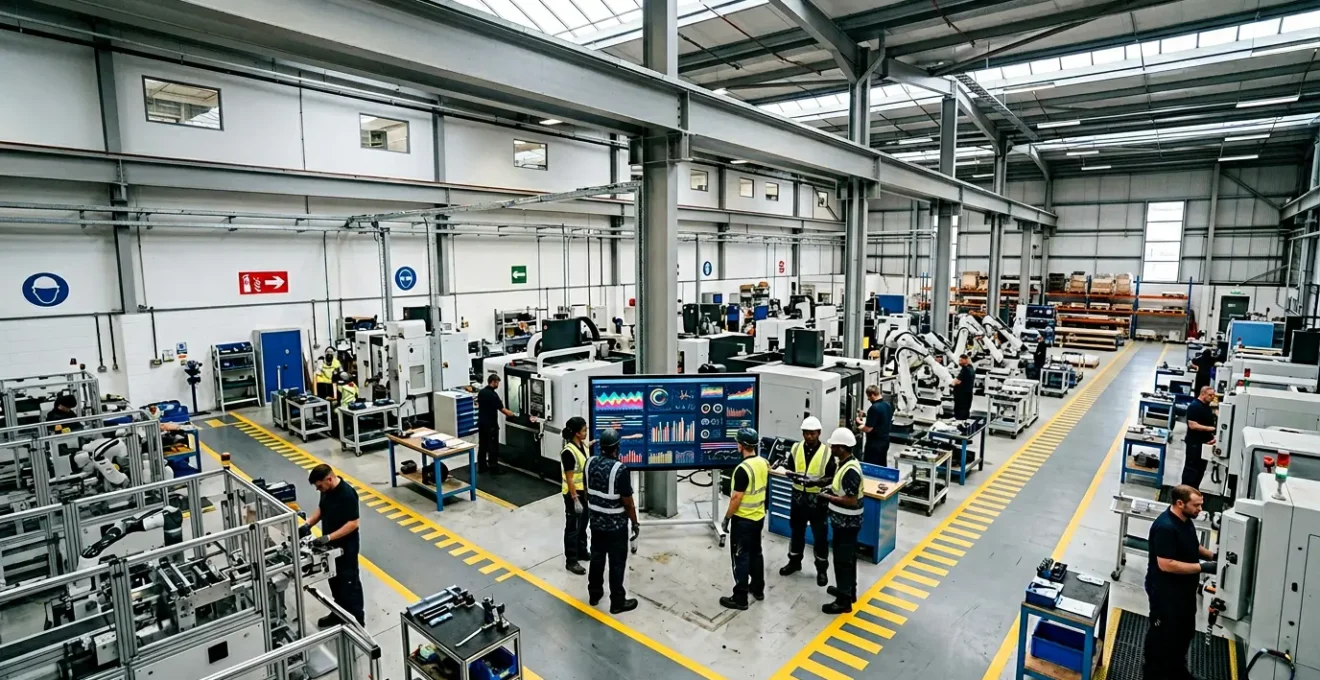
The biggest mistake in boosting factory output is pushing every machine to 100% capacity; it creates chaos, not value.
- True production speed is dictated by your single biggest bottleneck, not the average speed of all machines.
- Large, « efficient » batches are a primary cause of hidden costs, creating massive backlogs and WIP inventory.
Recommendation: Stop chasing 100% utilisation and start obsessing over flow velocity. Identify and elevate your primary constraint to unlock the entire system’s potential.
The pressure is relentless. Every day, as a Plant Manager, you’re tasked with increasing daily yield, meeting tighter deadlines, and doing it all without authorising expensive overtime. The conventional wisdom offers familiar solutions: invest in faster machines, implement the latest lean manufacturing buzzwords, or simply push the existing system harder. These approaches often lead to firefighting, burnout, and bloated work-in-progress (WIP) inventories that clog the factory floor.
But what if the relentless pursuit of maximum capacity is the very thing holding your factory back? What if the secret to greater output isn’t about making every machine run faster, but about making the entire production process flow smoother? This is the core principle of continuous flow manufacturing, a perspective that shifts the focus from isolated efficiencies to systemic effectiveness. It’s a move away from celebrating a busy factory to celebrating a productive one.
This guide offers a different path. It’s an industrial engineer’s approach to looking at your entire production system, from the physical layout of your assembly line to the digital flow of information. We will deconstruct the common myths about productivity and provide a practical framework to identify the real constraints that are throttling your output. By the end, you’ll have a clear, actionable strategy to streamline your workflows, increase your daily yield, and achieve sustainable growth—all without simply throwing more money or hours at the problem.
This article provides a comprehensive roadmap for rethinking your production strategy. Discover how to identify hidden bottlenecks, reconfigure your workspace for optimal flow, and implement lean principles that genuinely accelerate your production schedules, not just add more process.
Summary: A Practical Guide to Unlocking UK Manufacturing Potential
- Why Does Pushing Machines to Maximum Capacity Actually Slow Down Production Workflows?
- How to Reconfigure Your Assembly Line Layout to Reduce Material Handling Time?
- Cellular Manufacturing vs Traditional Lines: Which Suits Bespoke UK Orders?
- The Batch Size Mistake That Creates Massive Inter-Departmental Backlogs
- Reducing Machine Setup Times to Accommodate Smaller Profitable Production Runs
- How to Map Your Value Stream to Identify Hidden Production Bottlenecks?
- How to Implement Preventative Maintenance to Preserve Equipment Resale Value?
- How to Drive Lean Process Implementation to Accelerate Production Schedules?
Why Does Pushing Machines to Maximum Capacity Actually Slow Down Production Workflows?
The intuition seems logical: to get more out, you run everything at full tilt. Yet, this is often the most significant strategic error a plant manager can make. The reality is that a factory is not a collection of independent machines; it’s an interconnected system. The speed of this system is not determined by the average speed of its parts, but by the speed of its slowest part—the bottleneck. Pushing non-bottleneck machines to 100% capacity doesn’t create more finished goods; it creates mountains of work-in-progress (WIP) that pile up before the constraint, causing chaos, increasing handling costs, and extending lead times.
This phenomenon is central to the Theory of Constraints (TOC). When you overproduce upstream, you’re not just wasting machine hours; you’re consuming raw materials, energy, and labour to create inventory that may not be needed, introducing the risk of damage or obsolescence. This « busy capacity » feels productive but actively harms flow velocity. As a case in point, UK manufacturer Raybloc dramatically reduced customer lead times from 22 weeks to just 6 by applying TOC. They achieved this not by speeding up every machine, but by controlling WIP levels and focusing all improvement efforts on their single CNC bottleneck.
The economic impact of this shift in thinking is substantial. It’s estimated that a 10% productivity uplift across UK manufacturing could generate an additional £62 billion for the economy. This gain won’t come from running machinery into the ground. It will come from optimising the entire system for smooth, predictable flow. The goal is to subordinate every part of the production process to the pace of the constraint, ensuring it is never starved of work and never overwhelmed by upstream overproduction.
By shifting the focus from individual machine utilisation to overall system throughput, you begin to manage the flow of value, not just the movement of parts. This is the first and most critical step towards genuinely streamlining your production workflow.
How to Reconfigure Your Assembly Line Layout to Reduce Material Handling Time?
Once you accept that production is about flow, the physical layout of your factory becomes a critical strategic asset, not just a collection of workstations. Excessive material handling—the time spent moving parts between processes—is a form of waste that adds no value for the customer. It extends lead times, increases the risk of damage to components, and consumes valuable labour. A common sign of a poor layout is a « spaghetti diagram » where the path of a single product crisscrosses the factory floor multiple times. The goal is to straighten this path into a direct, logical, and short-as-possible line.
Optimising your layout starts with mapping the current flow. For each product family, trace the journey from raw material to finished goods. Identify areas of backtracking, long travel distances, and temporary storage points. The ideal layout often takes the form of a ‘U-shaped’ cell, where input and output points are close together, minimising operator movement and facilitating communication. You must also design clear material flow paths, often marked with floor tape, to separate pedestrian traffic from forklift routes and ensure materials are staged in designated, easy-to-access locations, not just dropped wherever there is space.
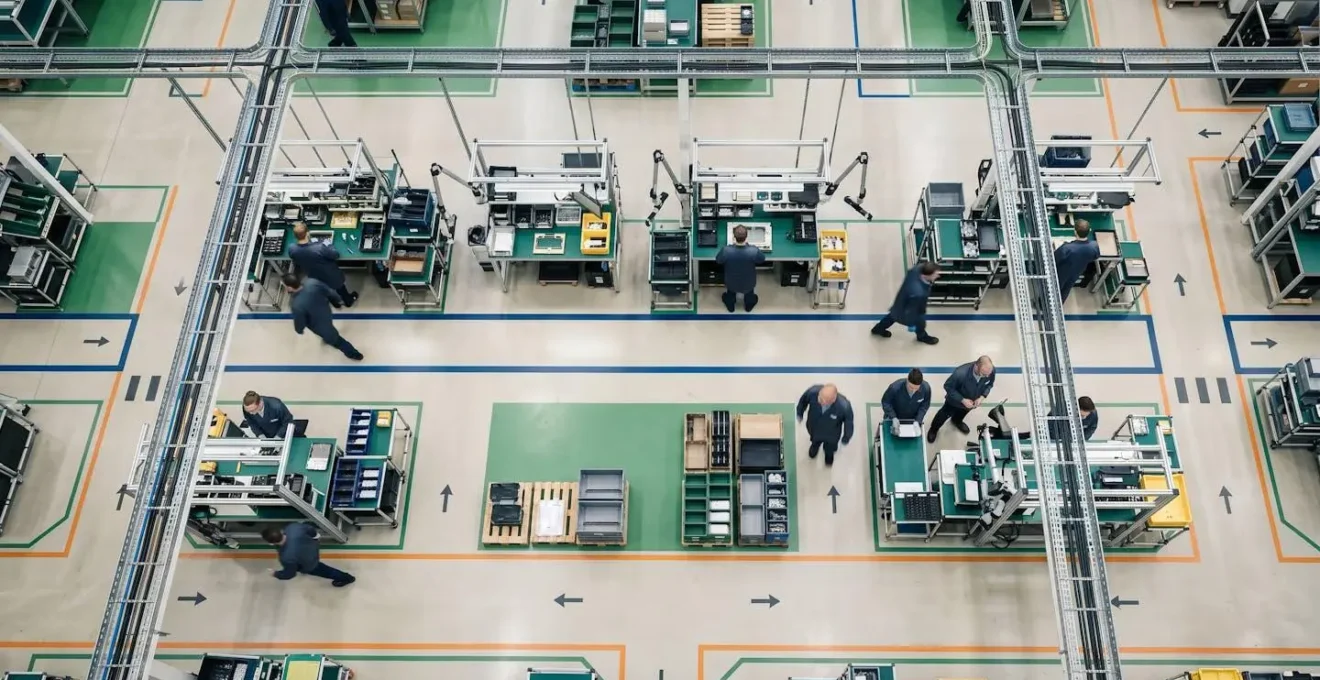
Historically, testing a new layout was a costly and disruptive process. Today, however, digital tools offer a low-risk, high-reward alternative. Instead of physically moving heavy machinery, you can simulate changes using Digital Twin software. This allows you to test multiple layout scenarios, analyse their impact on material flow and throughput, and identify potential issues before committing to a physical change. For UK manufacturers, support for this technology is often available through government initiatives.
The following table, based on industry data, highlights the stark differences between testing methods. For a plant manager looking to maximise output without incurring massive capital expenditure or operational downtime, the choice is clear.
| Method | Time to Test | Cost | Risk Level | UK Support |
|---|---|---|---|---|
| Physical Reconfiguration | 4-8 weeks | £50k-200k | High | Limited |
| Digital Twin Simulation | 1-2 weeks | £5k-20k | Low | Made Smarter program |
| Paper-based Planning | 2-3 weeks | £2k-5k | Medium | None |
Ultimately, a well-configured assembly line makes the right way to work the easiest way. It transforms the physical space from a simple container for machines into an active part of your streamlined production engine.
Cellular Manufacturing vs Traditional Lines: Which Suits Bespoke UK Orders?
The traditional assembly line, perfected for mass production of identical items, struggles with the modern demands of high-mix, low-volume manufacturing. For UK manufacturers increasingly competing on customisation and responsiveness, a more agile approach is needed. This is where cellular manufacturing excels. Instead of a long line of specialists each performing one task, a ‘cell’ is a self-contained unit where a multi-skilled team works on a product from start to finish. It’s like creating a small, focused factory within your factory.
This layout is particularly suited for bespoke orders. In a traditional line, a custom product can disrupt the flow for everyone. In a cellular model, one cell can handle the custom order while others continue with standard products, causing minimal disruption. This drastically reduces lead times for specialised items, improves quality through immediate feedback within the team, and fosters a strong sense of ownership and accountability among workers. This is crucial in a market where UK manufacturing employs 2.6 million people earning an average of £41,220, highlighting the need to leverage these skilled workers’ full potential, not just their ability to perform a single repetitive task.
The primary barrier to implementing cellular manufacturing is often the need for a multi-skilled workforce. A cell cannot function if workers are unable to operate different machines or perform various assembly and inspection tasks. Forward-thinking UK firms are overcoming this hurdle by reframing it as a strategic investment in their people. A compelling example is the use of the Apprenticeship Levy. Instead of viewing it as a mere tax, companies are using these funds to create robust cross-training programs. This turns a mandatory financial obligation into a powerful engine for building the flexible, highly-skilled workforce necessary to thrive with a cellular model, as demonstrated by the North West’s leading £29.5bn output, which is heavily reliant on such agile production methods.
For a plant manager dealing with a high number of custom or bespoke orders, the question isn’t whether you can afford to implement cellular manufacturing, but whether you can afford not to. It’s a direct path to meeting customer demands for customisation without sacrificing efficiency.
The Batch Size Mistake That Creates Massive Inter-Departmental Backlogs
One of the most pervasive and damaging myths in manufacturing is that large batches are more efficient. The logic is based on minimising setup time per piece; if a machine takes an hour to set up, running 1,000 units seems more « efficient » than running 10. However, this logic is fatally flawed because it only considers the efficiency of one isolated machine, not the health of the entire production system. This « big batch » thinking is the primary cause of inter-departmental backlogs and bloated WIP inventory.
When one department produces a large batch, it floods the next department with a mountain of parts. This creates a huge queue, hides quality defects (a flaw on the first part might not be discovered until the 1,000th is made), and ties up enormous amounts of cash in inventory. The ideal, in contrast, is the concept of « one-piece flow, » where products move through the production process one unit at a time. This minimises lead time, exposes problems immediately, and dramatically reduces the capital tied up in WIP. This lean approach is a key reason why UK manufacturing added a £21bn increase in output despite having 36,000 fewer workers in a recent period; it’s a testament to working smarter, not harder.
Transitioning from large batches to smaller, more frequent runs is a cultural and operational shift. It requires a relentless focus on reducing setup times (more on that next) and reconfiguring work cells to facilitate a smooth, continuous flow. The goal is to make the « economic batch size »—the batch size that is most profitable for the entire system—as close to one as possible.
Your Action Plan: Auditing for One-Piece Flow
- Points of contact: Map the journey of a single high-value order through every workstation, noting all queue times and handoffs where it waits as part of a batch.
- Collecte: Quantify the total cost of your current Work-In-Progress inventory, including material cost, storage space, and capital tied up at current UK interest rates.
- Cohérence: Confront your batch sizes with your quality data. Where are defects being discovered? How many other items in the batch are affected when a problem is found?
- Mémorabilité/émotion: Identify where flow stops. Pinpoint the large stacks of inventory between departments and contrast them with the ideal of a single component moving smoothly.
- Plan d’intégration: Prioritise one product family and create a pilot cell to trial one-piece flow, measuring the drastic lead time reduction as your primary success metric.
By challenging the « efficiency » of large batches and embracing the velocity of one-piece flow, you can unclog your production arteries and create a far more responsive and profitable operation.
Reducing Machine Setup Times to Accommodate Smaller Profitable Production Runs
The single biggest objection to smaller batch sizes is the perceived « waste » of machine setup times. If a changeover takes hours, the pressure to run large batches is immense. The solution is not to surrender to large batches but to attack the setup time itself. This is the goal of SMED (Single-Minute Exchange of Die), a systematic methodology for dramatically reducing changeover times, ideally to under 10 minutes (« single-digit »).
The core principle of SMED is to differentiate between two types of setup tasks. External tasks are those that can be performed while the machine is still running (e.g., gathering new tools, pre-heating a mold, preparing documentation). Internal tasks are those that absolutely require the machine to be stopped (e.g., physically swapping a die, final calibration). The tragic mistake most factories make is performing many external tasks internally, leading to excessive downtime. The first step in any SMED initiative is to observe a changeover and rigorously separate these two types of activities.
Once separated, the goal is to convert as many internal tasks as possible into external ones. For example, instead of finding the next tool after the machine stops, have it ready on a prepared cart. The remaining internal tasks are then streamlined using techniques like quick-release clamps, standardised tool heights, and visual guides. This methodical approach has enabled many UK manufacturers to successfully compete with overseas factories by making high-mix, low-volume production profitable. By mastering SMED, they can offer the product variety that was previously only feasible through outsourcing to high-volume Asian facilities, effectively supporting the UK’s reshoring trend.
To begin, you can analyse your setup process with a simple checklist approach:
- External tasks (while machine runs): Pre-staging of tools and dies, pre-heating or cooling of molds, preparation of all necessary documentation and quality gauges.
- Internal tasks (machine stopped): The physical die or tool change, final machine calibration, and the crucial first-piece inspection.
- Quick-win improvements: Standardising nuts and bolts to reduce the number of wrenches needed, using quick-release mechanisms instead of traditional bolts, and creating visual guides for precise alignment.
By treating setup time as a process to be improved rather than an unavoidable cost, you unlock the operational flexibility needed to thrive in a market that demands customisation and speed.
How to Map Your Value Stream to Identify Hidden Production Bottlenecks?
You can’t fix what you can’t see. A Value Stream Map (VSM) is a powerful visualisation tool that helps you see the entire flow of material and information required to bring a product to your customer. It goes beyond a simple process map by capturing critical data at each step: cycle time, changeover time, uptime, and, most importantly, the waiting time (inventory) between steps. This allows you to see not just what you do, but how much time is spent doing nothing—which is often the vast majority of a product’s lead time.
Creating a VSM is a hands-on process. You literally walk the factory floor, from the shipping dock back to the raw material stores, tracing the path of a product family and gathering real-world data. The goal is to identify sources of waste and pinpoint the true bottleneck. The bottleneck is not always the machine with the longest cycle time; it’s the process with the largest queue of inventory sitting in front of it. The VSM makes these queues painfully visible, highlighting where your flow is breaking down. This diagnostic rigour is essential for the UK manufacturing sector, which contributed £220bn in output and ranks 11th largest globally, to maintain its competitive edge.
The traditional VSM focuses primarily on time and material, but the methodology has evolved to address modern business pressures. A plant manager today can use different « lenses » for their value stream map to tackle a wider range of strategic objectives, from environmental compliance to supply chain resilience.
This table illustrates how different types of VSM can address specific UK-centric challenges:
| Mapping Type | Focus Area | UK Benefit | Compliance Support |
|---|---|---|---|
| Traditional VSM | Time & Material Flow | Efficiency Gains | ISO 9001 |
| Carbon VSM | Energy & Emissions | ESG Compliance | Net Zero targets |
| Digital VSM | Data & Approvals | Reduced Admin | GDPR/Digital |
| Brexit VSM | Customs & Logistics | Supply Chain Resilience | UK Border Requirements |
A VSM is not a one-time exercise. It should be a living document that you use to create a « Future State » map, outlining a vision for a leaner, faster process. It becomes your strategic roadmap for continuous improvement, ensuring your efforts are focused on the areas that will have the greatest impact on the entire system.
How to Implement Preventative Maintenance to Preserve Equipment Resale Value?
In a production environment focused on throughput, maintenance can often be seen as a necessary evil—a cost centre that interrupts production. This is a short-sighted view. A strategic, well-documented preventative maintenance (PM) program is not a cost; it’s an investment that pays dividends in three ways: it reduces unplanned downtime, improves operational safety, and, crucially, preserves the resale value of your capital equipment.
When the time comes to upgrade or reconfigure a production line, the ability to sell existing machinery at a high price can significantly offset the cost of new equipment. Buyers of used industrial machinery prize two things above all else: reliability and a verifiable history. A machine that comes with a complete, digitally-archived maintenance record—detailing every service, every part replaced, and every calibration—is vastly more valuable than one with a questionable past. Using only Original Equipment Manufacturer (OEM) parts and retaining all documentation is a critical component of this strategy.
Modern technology is making this easier and more valuable than ever. UK manufacturers are increasingly retrofitting older equipment with affordable IoT sensors to monitor performance, temperature, and vibration. This data feeds into a predictive maintenance (PdM) system, which can forecast potential failures before they happen. This not only maximises uptime but also creates an invaluable digital log of the machine’s health. What’s more, for UK firms, such an initiative, which involves technical problem-solving and innovation, can often qualify for valuable R&D tax credits, turning a maintenance strategy into a direct financial benefit for the company.
To maximise the asset value of your machinery, your maintenance program should be structured with resale in mind. This involves a systematic approach to documentation and care:
- Document all maintenance activities with photos and detailed service records in a digital format.
- Maintain a complete portfolio of original equipment manuals and technical specifications.
- Preserve the machine’s external appearance through regular cleaning, as this heavily influences perceived value.
- Schedule a professional third-party inspection before a planned sale to certify the equipment’s condition and command a premium price.
By viewing maintenance through the lens of asset management, a plant manager can transform the maintenance department from a cost centre into a key contributor to the company’s financial health and long-term strategic flexibility.
Key takeaways
- True factory performance is dictated by your single biggest constraint (bottleneck), not the average utilisation of all machines.
- The pursuit of « efficiency » through large production batches is a primary cause of backlogs, high inventory costs, and slow lead times.
- Flow is king: success should be measured by the velocity of an order through the entire system, not the output of individual workstations.
How to Drive Lean Process Implementation to Accelerate Production Schedules?
Driving a lean transformation is not about implementing a dozen tools at once; it’s about fostering a culture of continuous improvement focused on eliminating waste and maximising value for the customer. All the concepts we’ve discussed—from attacking bottlenecks with Theory of Constraints, reconfiguring layouts for flow, reducing batch sizes, and mastering quick changeovers—are components of a comprehensive lean implementation. The goal is to create a system that is inherently faster, more flexible, and less wasteful.
The journey begins with leadership. As a Plant Manager, your role is to champion the vision and empower your team. This means moving from the office to the « Gemba »—the actual place where work is done. By observing processes firsthand, you can identify frustrations and inefficiencies that are invisible on a spreadsheet. Engaging your workforce, including union representatives in a UK context, is paramount. Frame lean not as a tool for job reduction but as a method to make work safer, less frustrating, and more rewarding. When employees see that their ideas for improvement are valued and implemented, they become the engine of the transformation.
This creates a virtuous cycle. As you streamline processes and reduce waste, you free up capacity. This newfound capacity should not be used to create more WIP, but to take on more orders, reduce lead times further, or develop new products. It accelerates your entire production schedule by removing the systemic friction that causes delays. The focus shifts from constant firefighting and expediting urgent orders to running a calm, predictable, and highly efficient operation where on-time delivery becomes the norm, not a daily struggle.
Your next step isn’t a budget request for new machinery, but a focused effort to map your value stream with your team. Identify your top three sources of waste and launch a pilot project to eliminate them. This first small win will build the momentum needed to drive a lasting lean transformation and accelerate your production schedules beyond what you thought possible.
Frequently Asked Questions on How to Streamline Production Workflows for Maximum UK Factory Output?
How can UK manufacturers overcome workplace skepticism about Lean?
Focus on ‘what’s in it for me’ benefits like safer conditions and less frustrating work, using Gemba walks to demonstrate leadership commitment.
What UK funding is available for Lean implementation?
Innovate UK and local LEPs offer grants when Lean is framed as innovation or competitiveness enhancement initiatives.
How do you engage unionised UK workforces in Lean?
Emphasize empowerment, involve union representatives early, and demonstrate how Lean improves working conditions rather than replacing jobs.