
The biggest drain on your production schedule isn’t machinery; it’s the invisible administrative friction between process steps.
- Most ‘waste’ is created not by inefficient workers, but by excessive approval delays, data hand-offs, and reporting cycles that create decision latency.
- Digital Process Mining can reveal the true, complex paths of workflow that manual Value Stream Mapping often misses, pinpointing the source of delays with objective data.
Recommendation: Focus relentlessly on empowering your team to question and eliminate approval loops and redundant checks before you even consider automating a task.
As a UK Operations Director, you’re on the front line. The pressure to shorten delivery cycles to compete with nimble European imports is relentless. The standard playbook tells you to hunt for waste on the factory floor, to streamline physical processes, and to implement classic Lean tools. You’ve likely tried mapping your value streams and have run Kaizen events. Yet, despite these efforts, do customer wait times remain stubbornly high? Are your production schedules still vulnerable to unforeseen delays?
The common approach often misses the real culprit. We’re conditioned to look for waste we can see—excess inventory, unnecessary motion, physical bottlenecks. But in modern manufacturing, the most significant delays are invisible. They live in the gaps between process steps: in email inboxes awaiting approval, in spreadsheets being manually updated, and in meetings where decisions are deferred. This is administrative friction, the silent killer of productivity and the primary source of customer frustration.
But what if the true key to unlocking speed wasn’t just about optimising the factory floor, but about surgically removing this administrative drag? This guide moves beyond the textbook definitions of Lean. It provides a pragmatic framework for you, the operational leader, to identify and eliminate the non-value-added steps that are truly holding your business back—the ones hidden in your workflows and approval chains. We will explore how to quantify their cost, diagnose their root causes, and implement targeted solutions to reclaim your schedule and restore your competitive edge.
This article provides a structured approach to tackling this challenge. We will dissect the problem from its financial impact to the practical tools required for its eradication, equipping you with a clear roadmap for action.
Contents: Slashing Delivery Cycles by Eliminating Waste
- Why Do Non-Value-Added Steps Quietly Inflate Your Manufacturing Costs by 20%?
- The Workflow Mapping Oversight That Paralyses Entire Factory Floors
- Value Stream Mapping vs Process Mining: Which Identifies Hidden Waste Best?
- Solving the Excessive Middle Management Approvals That Delay Client Deliveries
- When Should You Automate a Repetitive Task Versus Eliminating It Completely?
- How to Map Your Value Stream to Identify Hidden Production Bottlenecks?
- How to Identify Zombie Processes That Consume Without Generating Value?
- How to Drive Lean Process Implementation to Accelerate Production Schedules?
Why Do Non-Value-Added Steps Quietly Inflate Your Manufacturing Costs by 20%?
Non-value-added (NVA) steps are any actions in a process that consume resources but do not add value from the customer’s perspective. Your customer pays for a quality product, delivered on time; they do not pay for the time a component spends waiting for inspection, a report sits in an inbox, or a team debates a decision that could be automated or delegated. While seemingly minor, the cumulative effect of this administrative friction is a significant and often hidden tax on your entire operation. It doesn’t just delay schedules; it directly inflates overheads, ties up working capital in work-in-progress (WIP), and erodes your profit margins.
This isn’t theoretical. The impact of aggressively tackling these NVA steps is profound. Consider the transformation at Daman Products, a case that demonstrates the scale of the opportunity. By implementing a suite of Lean principles aimed at eliminating waste, the company achieved staggering results. A detailed analysis shows they managed to reduce cycle times by 97% and lead times from 4–8 weeks down to a mere 5–10 days. This was accomplished by focusing on cellular factories, pull scheduling, and critically, employee empowerment to identify and remove waste. They didn’t just work harder; they eliminated the work that didn’t matter.
The financial argument is compelling. The cost of NVA activities—waiting, rework, excess processing, unnecessary approvals—can easily account for 20% or more of your total manufacturing costs. This is capital that could be reinvested in R&D, better equipment, or higher margins. Identifying these costs is the first step toward reclaiming them. By shifting the focus from ‘how can we do this faster?’ to ‘why are we doing this at all?’, you begin to uncover the enormous financial burden of processes that have outlived their usefulness.
This hidden 20% isn’t just a number; it’s your competitive disadvantage. Eliminating it is the most direct path to improving profitability without sacrificing the quality your customers demand.
The Workflow Mapping Oversight That Paralyses Entire Factory Floors
Most Operations Directors are familiar with workflow mapping. The classic approach involves a team with a stopwatch and a clipboard, walking the floor and charting the physical journey of a product from raw material to finished goods. While valuable, this method suffers from a critical oversight: it prioritizes the visible flow of materials over the invisible flow of information and decisions. This oversight is what paralyses entire factory floors, creating gridlock that standard maps can’t explain.
You see the symptoms everywhere: operators waiting for instructions, pallets of sub-assemblies piling up, and urgent orders getting stuck « somewhere in the system. » These are not typically failures of physical machinery but failures of the administrative process that governs it. The real bottlenecks are the email approvals, the manual data entry into the ERP, the missing signatures on quality checks, and the inter-departmental hand-offs that create immense periods of waiting.
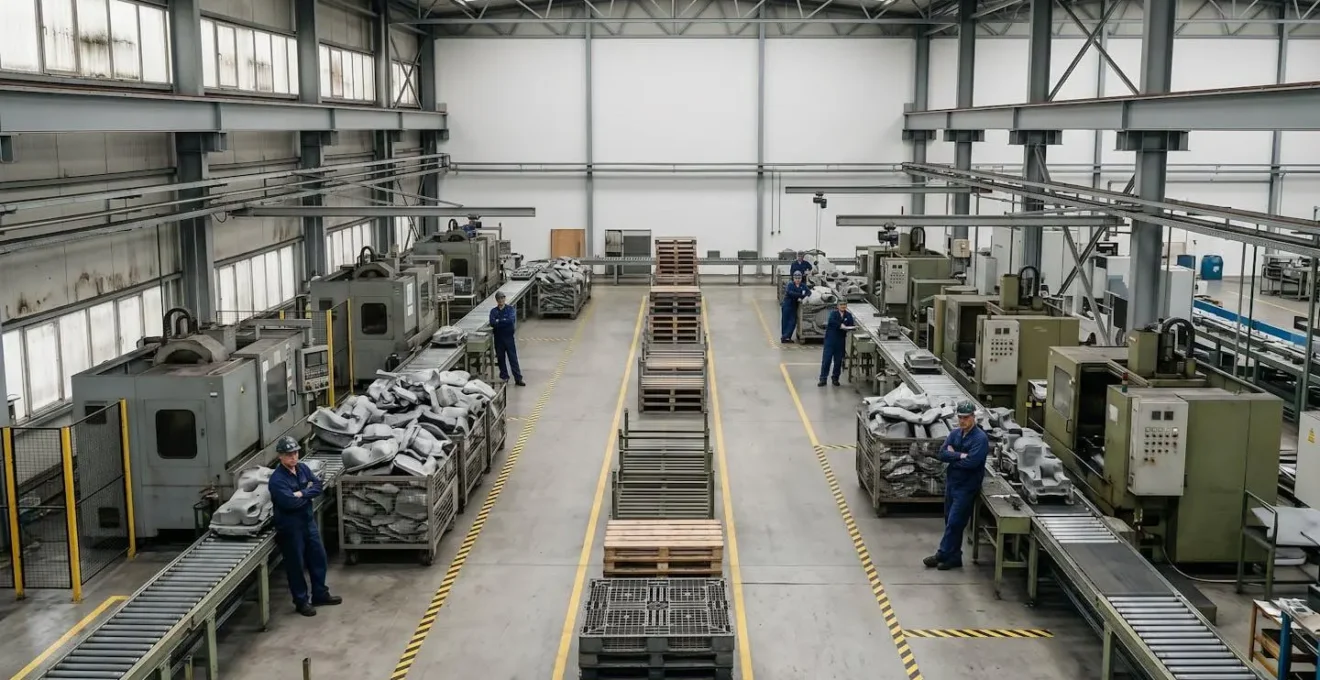
As the image above illustrates, congestion is rarely uniform. It accumulates at specific checkpoints where the administrative process breaks down. Your workflow map is incomplete if it doesn’t meticulously chart these non-physical steps. A truly effective map must trace not just the part, but the purchase order, the work order, the quality assurance report, and the shipping confirmation. It needs to ask: Where does information wait? Who needs to approve this? How is that approval communicated? How long does it take?
The paralysis stems from treating the factory like a simple, linear system when it’s a complex network of physical actions and digital authorisations. The most common oversight is failing to engage frontline workers and elicit their ideas for improvement. They are acutely aware of where the delays are. A mapping exercise that doesn’t start with them is destined to only capture a fraction of the problem. By focusing only on the physical, we miss the administrative friction that accounts for the vast majority of lead time.
To break this paralysis, you must make the invisible visible. Your next mapping exercise should spend less time on the shop floor and more time tracing the digital and paper trails that truly dictate the pace of your operation.
Value Stream Mapping vs Process Mining: Which Identifies Hidden Waste Best?
Once you accept that administrative friction is the primary enemy, the question becomes: what is the best tool to find it? For decades, Value Stream Mapping (VSM) has been the go-to method. It’s a powerful, collaborative tool for visualising a process and separating value-added from non-value-added steps. However, in today’s complex, data-rich manufacturing environments, traditional VSM has limitations. It provides a ‘snapshot’ in time, is based on manual data collection, and can be influenced by subjective interpretation. This is where Process Mining emerges as a powerful, data-driven alternative.
Process Mining doesn’t rely on interviews or observations. Instead, it uses the digital footprints left in your existing IT systems (ERP, MES, CRM) to automatically reconstruct how your processes *actually* run, not how they are *supposed* to run. It analyses event logs to create a dynamic, objective view of every process variant, deviation, and delay. It turns subjective guesswork into factual analysis.
The choice is not about replacing VSM entirely but understanding which tool is best suited for the task of identifying hidden waste. VSM excels at building team consensus and visualising a future ‘Should-Be’ state, while Process Mining excels at diagnosing the complex reality of the ‘As-Is’ state with forensic precision. For an Operations Director tasked with untangling complex approval chains and data hand-offs, Process Mining offers a level of insight that manual mapping simply cannot match.
This table summarises the core differences, highlighting how Process Mining provides the objective facts needed to tackle complex administrative bottlenecks. The data is drawn from a detailed comparative analysis of the two methodologies.
| Aspect | Value Stream Mapping | Process Mining |
|---|---|---|
| Data Collection | Manual capture through interviews and stopwatches on the production floor | Reconstructs business processes based on their digital traces in various IT systems |
| Analysis Type | Provides ‘Should-Be’ view of processes | Analysis based on objective facts rather than subjectively captured information |
| Time Perspective | Provides a ‘snapshot’ of a process at a specific time | Enables a holistic view and guarantees repeatability at any time |
| Waste Detection | Identifies waste through observation and analysis | Quickly uncovers reasons for long waiting times and unnecessary process loops using root cause analysis |
Ultimately, the best approach often combines both: using the broad strokes of VSM to identify key areas of concern and then deploying Process Mining to conduct a deep, data-driven investigation into the root causes of delay within those areas.
Solving the Excessive Middle Management Approvals That Delay Client Deliveries
One of the most potent forms of administrative friction is the approval bottleneck. In many established UK manufacturing firms, legacy processes have created complex webs of sign-offs required for even minor decisions. A manager’s signature, once a mark of quality control, can become a primary cause of delay, creating significant ‘decision latency’ that ripples through the entire production schedule. Each hand-off to a manager for review is a potential queue, and when multiple approvals are stacked, lead times can explode.
The problem is often cultural. Approvals are tied to authority and a perceived sense of control. Challenging them can be politically sensitive. Yet, from a Lean perspective, an approval is a classic non-value-added step if it doesn’t actively prevent a defect or add tangible value the customer would pay for. Your task as a leader is to reframe the conversation from « who needs to approve this? » to « what is the lowest-cost, fastest way to guarantee a correct outcome at this step? ».

The solution lies in systematically replacing subjective, batch-based approvals with rule-based, flow-based systems. This means empowering frontline staff with clear guidelines, checklists, and tolerance levels. If a measurement is within spec, the process moves on automatically. An approval is only required for exceptions. This shifts managers from being gatekeepers to being coaches and problem-solvers for the exceptions that truly require their expertise.
Adopting a pull-based approach to scheduling work is fundamental to dismantling these bottlenecks. Instead of pushing work into queues that wait for approvals, work is pulled through the system based on actual capacity and demand, making delays immediately visible and forcing a resolution.
Action Plan: Optimising Approval Flows
- Implement Pull-based Planning: Schedule work based on actual demand and capacity, not forecasts. This prevents building up queues that wait for approvals.
- Ensure Continuous Flow: Design the process to move smoothly without delays. If a step requires approval, question why it can’t be a simple, instant check against a clear standard.
- Focus on Waste Elimination: Vigorously identify and remove non-value-adding activities from the schedule, with a primary focus on ‘waiting for approval’ time.
- Adopt a Pull System: Instead of pushing work to the next stage, have the next stage ‘pull’ it when ready. This makes bottlenecks instantly visible and creates pressure to resolve them.
- Delegate or Automate Decisions: For every approval step, ask: « Can this be defined by a rule and automated? Or can we train and trust the operator to make the call? ».
This isn’t about removing oversight; it’s about making oversight more intelligent, targeted, and respectful of the most valuable resource you have: time.
When Should You Automate a Repetitive Task Versus Eliminating It Completely?
In the drive for efficiency, automation is often presented as the ultimate solution. The temptation to throw technology at a repetitive, time-consuming task is strong. However, this is a dangerous trap for an operational leader. The first rule of smart automation is a core tenet of Lean thinking: do not automate a process you have not first simplified and stripped of waste. Automating a wasteful process doesn’t eliminate waste; it just makes the waste move faster, cementing inefficiency into your operations at a significant capital cost.
The critical question to ask before any automation project is not « Can we automate this? » but « Should this task exist at all? ». Apply the ECRS framework:
- Eliminate: Can we get rid of this step entirely? What would happen if we just stopped doing it? This is the most powerful and cheapest option.
- Combine: If it can’t be eliminated, can it be combined with another step to reduce hand-offs?
- Rearrange: Can changing the sequence of steps reduce waiting or motion?
- Simplify: Can the task be made less complex, requiring less skill or time?
Only after you have exhausted these options should automation be considered. Automation is the correct choice when a task is repetitive, rule-based, and genuinely adds value, but its manual execution is slow, prone to human error, or a source of drudgery for your skilled staff. Think of tasks like data entry, generating standard reports, or monitoring machine performance against set parameters.
The experience of Penn Color provides a powerful lesson in this strategic thinking. Faced with what they thought was a capacity crisis, their first instinct could have been to buy new machinery. Instead, they focused on eliminating the waste in their manual data tracking processes. By replacing error-prone manual tracking with an automated data collection system, they didn’t just speed up a task; they eliminated the inefficiencies caused by bad data throughout their entire operation. The result was not just faster data, but the discovery of ‘hidden capacity’ within their existing equipment and workforce. This is the true power of strategic automation: it’s not about making a bad process faster, but about enabling a good process to perform optimally.
Before you sign a purchase order for that new robot or software suite, challenge your team one last time: have we earned the right to automate this, or is there still waste we can eliminate for free?
How to Map Your Value Stream to Identify Hidden Production Bottlenecks?
Value Stream Mapping (VSM) is your primary tool for making waste visible. A proper VSM tells the story of your product from the customer’s order to final delivery, meticulously documenting every step along the way. However, to truly uncover the hidden bottlenecks caused by administrative friction, your map must go beyond the physical flow. It must capture the parallel and often more convoluted flow of information.
The process begins by defining the scope. Choose a single product family or value stream and, as a team, walk the process from end to beginning. Start with the finished product at the shipping dock and work backwards. Why backwards? Because it forces you to think in terms of customer pull and keeps the focus on what the next step in the process *needs* from the previous one. A startling finding when organisations first map their value streams is that in many unoptimized end-to-end processes, they find 95% of time is spent waiting. This waiting is your primary target.
For each step, you must document not only the process time but, more importantly, the wait time between steps. This is where hidden bottlenecks are found. Your VSM should include:
- Process Steps: Both physical (e.g., ‘Cut material’) and informational (e.g., ‘Approve design’).
- Data & Metrics: For each step, capture cycle time, changeover time, uptime, and number of operators.
- Inventory & Waiting: Note any inventory (raw materials, WIP, finished goods) that builds up between steps. This represents capital sitting idle.
- Information Flow: Map how information (orders, schedules, reports) moves, both electronically and manually. Note the decision points, hand-offs, and interactions with other systems.
The most crucial part of VSM is the analysis. Once the ‘current state’ map is complete, the team must rigorously challenge every step. Ask the hard questions: which of these steps truly add value in the eyes of the customer? Which are non-value-added but currently necessary (e.g., compliance checks)? And which are pure waste that can be eliminated immediately? This analysis forms the basis of your ‘future state’ map—a leaner, faster process that becomes your implementation roadmap.
Remember, the map is not the goal. The goal is the conversation and the action that the map provokes. It is a tool for building shared understanding and a catalyst for change.
How to Identify Zombie Processes That Consume Without Generating Value?
Within your operations, there exist « zombie processes »—activities that shuffle along, consuming time, resources, and employee attention, yet generate no real value for the customer. They are the legacy reports nobody reads, the duplicate data entry fields, the review meetings with no clear purpose. They persist out of habit (« we’ve always done it this way ») and are often difficult to spot because they are woven into the fabric of the workday. Identifying and eliminating these zombies is pure, high-return efficiency gain.
The most effective tool for hunting these zombies is the classic Lean framework of the 8 Wastes, often remembered by the acronym DOWNTIME. Rather than a simple checklist, you should use this framework as a diagnostic lens. When you observe a delay or a quality issue, ask which of these eight waste categories it falls into. This helps you to label the problem and identify its root cause, moving from a general sense of inefficiency to a specific, targetable issue.
For example, seeing large stockpiles of components isn’t just ‘inventory’; it’s a waste that might be hiding deeper problems like production delays or quality issues in your supply chain. An operator walking across the floor to find a tool isn’t just ‘part of the job’; it’s the waste of ‘Motion’, which breaks workflow and wastes energy. By systematically applying this framework, you can give a name to these zombies and build a case for their elimination.
The following table breaks down the 8 Wastes of Lean. Use it not as a final list, but as a starting point for conversations with your team. Print it out, walk the floor, and ask your operators: « Where do you see these happening every day? »
| Waste Type | Description | Impact |
|---|---|---|
| Defects | Hurt efficiency and product quality, can result from design flaws, poor materials, or inadequate training | Slow production and drive up costs |
| Overproduction | Producing more than customer demand | Excess inventory and wasted resources |
| Waiting | People waiting on material or equipment and idle equipment | Can result in excess inventory and overproduction |
| Non-Utilized Talent | Not using employee skills effectively | Lost opportunities for improvement |
| Transportation | Unnecessary movement of materials | Increased costs and damage risk |
| Inventory | Often hides deeper problems like production delays or quality issues | Large stock levels mask when production lines run low on components. These problems only surface when inventory drops |
| Motion | Unnecessary movements during tasks, though seemingly minor—searching for tools, reaching for items, or walking across the floor | These small actions add up, wasting energy and breaking workflow |
| Extra-Processing | Doing more work than required | Unnecessary costs and time waste |
The true power of this framework is realised when your entire team is trained to see and name these wastes. It creates a shared language for improvement and empowers everyone to become a zombie hunter.
Key takeaways
- The most significant source of production delays in modern manufacturing is not physical, but ‘administrative friction’ found in approvals, hand-offs, and data flows.
- Data-driven tools like Process Mining are essential for uncovering the true complexity and root causes of delays that manual methods like VSM can miss.
- A « eliminate, combine, rearrange, simplify » approach must always precede any automation initiative. Never automate a wasteful process.
How to Drive Lean Process Implementation to Accelerate Production Schedules?
Driving a Lean transformation is not a project with a defined end date; it is a fundamental shift in operational culture. As a leader, your role is to move from theory to tangible results on the production schedule. This requires a clear framework, unwavering commitment, and the empowerment of your team. The goal is to create a continuous workflow, driven by customer demand, where problems are made visible and are solved immediately.
The results of a rapid, committed implementation can be dramatic. The case of NCR in Dundee, Scotland, stands as a testament to what is possible. In a make-to-order environment, they switched to a Just-in-Time (JIT) system over a single weekend. The transformation was immediate: inventory plummeted from 47 days to just 5, and flow time was slashed from 15 days to 2. This wasn’t a slow, incremental change; it was a decisive shift in operating philosophy that had an instant, massive impact on their production schedule and working capital.
Achieving such results requires a disciplined, step-by-step approach. Your implementation plan must be built on the following pillars:
- Define Value from the Customer’s Perspective: Everything starts here. You must have a crystal-clear understanding of what your customer needs and is willing to pay for. Everything else is potentially waste.
- Map the Value Stream: Identify every step in the process, highlighting the inefficient areas to eliminate. This creates a comprehensive view and a shared understanding of the problem.
- Implement a ‘Pull’ System: Shift from a forecast-driven (‘push’) model to a demand-driven (‘pull’) model. You only produce what is necessary, when it is needed, avoiding overproduction and excess stock.
- Foster a Culture of Continuous Improvement (Kaizen): This is the most critical element. Lean is not a one-time fix. You must create an environment where every employee is empowered and encouraged to identify waste and suggest improvements as an ongoing effort.
– Create Continuous Flow: Rework the process to ensure a smooth, uninterrupted workflow. This involves implementing quality control checkpoints at each stage and minimising unnecessary movements and handling.
Your leadership is the catalyst. By providing the vision, the tools, and the trust, you can unlock the hidden capacity within your factory and build a resilient, agile operation that thrives under pressure.